Why Cleaning Your LED Fixtures Matters More Than You Think
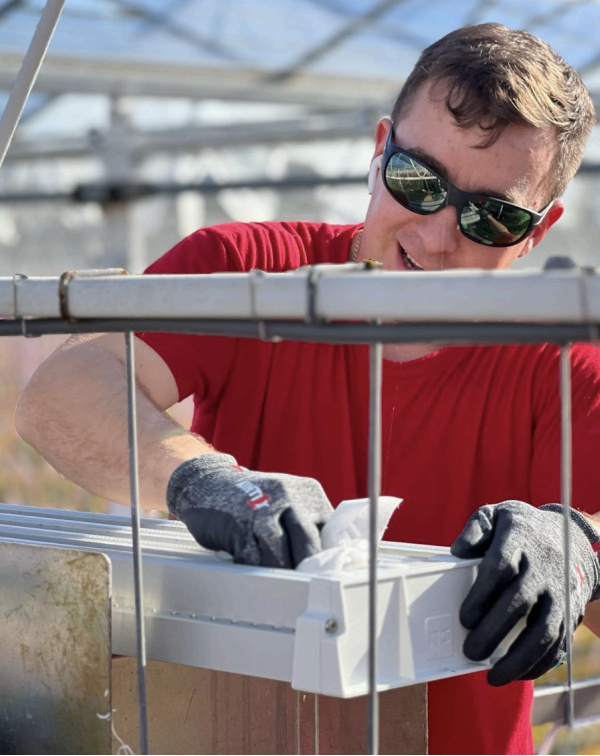
In a modern greenhouse, supplemental lighting is one of the largest investments a grower makes. LED fixtures are selected for their efficiency, reliability, light output, and long service life. But there is one part of lighting performance that is surprisingly easy to overlook:
The fixture can only deliver the light that successfully passes through its optics.
Over time, dust, residues, crop protection products, moisture deposits, organic material, and normal greenhouse activity can accumulate on LED lenses and fixture surfaces. Even when the contamination appears minor from the ground, it can already be affecting performance.
According to leading fixture manufacturer documentation, even a seemingly limited amount of contamination can reduce light output by as much as 15%. The same documentation explains that dirt absorbs light, increases product temperature, can negatively affect fixture lifetime, and that inadequate cleaning maintenance may affect warranty obligations.
That is why LED cleaning should not be viewed simply as housekeeping. It should be considered part of the greenhouse lighting strategy.
How can a little dirt actually reduce so much light?
An LED fixture is engineered to direct a precise amount of light toward the crop. The lens or optical surface is the last thing that light must pass through before reaching the canopy.
When that surface becomes contaminated, part of the emitted light is absorbed, scattered, or blocked before it reaches the plants.
Leading manufacturers specifically note that contamination of the lens plate reduces the light output of horticultural LED products and that relatively small amounts of dirt can already produce a significant reduction — up to 15% in some cases.
For a greenhouse operating hundreds or thousands of fixtures, that is important. The electrical power being consumed by the fixtures has not necessarily decreased, but less useful light may be reaching the crop.
In other words, a dirty fixture can gradually reduce the return on the energy you are already paying for.
Why is this particularly important in a greenhouse?
Greenhouses are demanding environments for lighting equipment.
Fixtures can be exposed to humidity, dust, crop debris, fertilizer residues, spraying activities, crop protection products, and other contaminants generated during normal production.
The amount of contamination is therefore not identical from one greenhouse to another.
Cleaning specialists recommend monitoring fixture contamination regularly and explain that maintenance frequency depends on conditions and daily activities within the greenhouse. Their guidance identifies lighting hours, chemical use, dust levels, and greenhouse temperature as factors that can influence the appropriate maintenance interval.
This means there is no perfect cleaning calendar that applies to every operation.
The correct question is not simply:
“When did we last clean the lights?”
It is:
“How quickly are our fixtures becoming contaminated under our production conditions?”
Does dirt only reduce light output?
No.
Reduced light output is only one part of the problem.
Dirt on the optical surface can also absorb light and contribute to additional heat at the fixture. Manufacturer documentation states that dirt on the lens plate absorbs light, increasing product temperature, which can negatively affect product lifetime.
Industry guidance similarly emphasizes the relationship between contamination, thermal performance, reliability, light loss, and fixture lifespan. Multiple fixture manufacturers state that regular maintenance helps prevent unnecessary light loss, increases reliability, and extends the lifetime of LED fixtures.
So cleaning is doing two jobs at once:
It helps maintain the optical performance of the luminaire while also supporting the thermal conditions the fixture was designed to operate under.
Why does this matter for the crop?
Plants do not respond to the electrical wattage printed on the fixture.
They respond to the photons that actually reach the crop.
A lighting plan may have been designed around a specific PPFD target, photoperiod, or Daily Light Integral strategy. If fixture contamination gradually reduces delivered light, the real growing environment can begin moving away from the original lighting design.
That loss can be difficult to notice because contamination normally accumulates progressively.
A fixture does not suddenly become 10% dirtier overnight. Performance can slowly decline over weeks or months while the fixtures still appear to be operating normally.
Industry guidance warns that contamination levels that may not even be clearly visible from a distance can already negatively affect performance and therefore recommends regular inspection of the fixtures.
This is one reason preventive maintenance is generally more useful than waiting until the lenses visibly look dirty.
Is dirt-related light loss permanent?
This is one of the most important distinctions.
Some LED light depreciation occurs naturally as lighting systems age. Dirt-related depreciation, however, can be at least partly recoverable through cleaning.
Research commissioned by the Illuminating Engineering Society describes luminaire dirt depreciation, or LDD, as a recoverable light-loss factor, in contrast with LED lumen depreciation that ultimately requires replacement of the light engine to recover.
The IES research provided in our reference material concerns street and roadway LED luminaires rather than horticultural fixtures, so its numerical results should not be directly transferred to a greenhouse. However, it reinforces an important lighting-engineering principle: contamination can alter delivered illumination, and cleaning can recover performance that would otherwise be mistaken for permanent fixture degradation.
That distinction matters when troubleshooting a greenhouse lighting system.
Before assuming an aging installation has permanently lost output, fixture cleanliness should be part of the evaluation.
Why use a purpose-designed LED cleaning wipe?
It may be tempting to use whatever cleaner or cloth is already available in the greenhouse.
That can create another problem.
LED optics are engineered surfaces and may be made from materials that can be scratched, clouded, chemically attacked, or left with residues by inappropriate cleaning products.
Manufacturers specifically warn against rough or coarse materials, scouring pads, bleach, solvents, non-approved cleaning agents, and dirty cloths. A contaminated cloth can leave residue, scratch the optics, or further reduce light output.
For commercial greenhouse LED fixtures, specialized single-use cleaning wipes have been developed and tested specifically for the type of optics used in horticultural lighting. They are intended for one-time use.
This is an important distinction.
A cleaning wipe is not valuable simply because it removes visible dirt.
It needs to remove contamination without creating a new optical or chemical problem in the process.
Why shouldn’t we simply use the same wipe over and over?
Because once a wipe removes contamination, that contamination is now in the wipe.
Continuing to drag the same heavily soiled material across the optics may redistribute residues or abrasive particles onto the next section of the fixture.
Manufacturers specify that cleaning wipes are intended for single use and advise checking that contamination has been completely removed.
Standard procedure similarly recommends turning the wipe over or replacing it when necessary while progressing across the LED bars.
The goal is not just to move dirt around.
The goal is to remove it from the optical surface.
How often should LED fixtures be cleaned?
There is no universal answer because contamination rates vary between greenhouses.
Industry specialists recommend weekly monitoring of contamination and provide a general recommendation to clean LED lenses approximately every 10 to 12 weeks, while stressing that actual frequency should depend on greenhouse conditions.
A practical maintenance program can therefore combine two approaches:
Routine inspection + condition-based cleaning.
Instead of blindly cleaning every fixture on an arbitrary date, growers can regularly inspect representative fixtures in different areas of the greenhouse and adjust the cleaning interval according to the level and speed of contamination.
Areas near spraying activity, dusty operations, doors, heating systems, or specific crop zones may also accumulate contamination differently.
Should only the lenses be cleaned?
No.
Optical cleanliness is essential because the lens directly affects light transmission, but the rest of the fixture also deserves attention.
Maintenance guidance recommends cleaning the complete fixture in addition to the lenses and highlights the importance of keeping the cooling fins clean.
Leading fixture manufacturers similarly recommend cleaning debris from the cooling area, including the use of compressed air or vacuum cleaning for the cooling fins.
That makes sense from a maintenance perspective: an LED luminaire is simultaneously an optical system, an electrical system, and a thermal-management system.
Maintaining only one of those components does not maintain the entire fixture.
Can improper cleaning damage the fixture?
Yes.
Cleaning needs to be performed according to the fixture manufacturer’s instructions.
Manufacturers recommend turning off and disconnecting the fixture before cleaning and warn against high-pressure water jets, abrasive materials, bleach, solvents, and non-approved cleaning products.
Standard maintenance protocols instruct operators to disconnect power and allow the fixture to cool before handling it. Industry guidance recommends allowing at least 30 minutes of cooling time before touching the lamp or fixture.
The exact procedure should always follow the manufacturer requirements for the specific luminaire being serviced.
Can poor maintenance affect the warranty?
Potentially, yes — and this is an often-overlooked reason to establish a documented maintenance program.
Several manufacturers state that overdue or inadequate cleaning maintenance may void warranty obligations for their LED products.
Industry guidance likewise warns that fixture contamination affects lifespan and that damage resulting from inadequate maintenance may be excluded from warranty coverage.
For a large commercial lighting installation, this makes maintenance documentation valuable.
Keeping records of inspection dates, cleaning dates, products used, and unusual contamination conditions can help demonstrate that the lighting system has been maintained properly.
What is the real cost of not cleaning your lights?
The cleaning wipe itself is inexpensive compared with what the fixture is responsible for.
Consider everything behind a commercial greenhouse LED installation:
the fixture investment, electrical consumption, lighting design, crop strategy, labor, cooling management, and expected fixture lifetime.
If contamination reduces the light reaching the crop while the fixtures continue consuming electricity, the grower is paying for photons that are not being fully delivered.
At the same time, dirt accumulation can increase thermal stress, potentially shorten fixture life, and introduce warranty concerns.
Cleaning therefore protects several things simultaneously:
light output, fixture reliability, thermal performance, service life, warranty compliance, and ultimately the return on the lighting investment.
What should a practical greenhouse LED maintenance program look like?
It does not need to be complicated.
Start by inspecting fixtures regularly rather than waiting for obvious dirt accumulation.
Establish representative inspection points throughout the greenhouse. Track how quickly contamination develops under your specific production conditions. Use cleaning materials approved for the fixture optics. Clean the lenses and appropriate fixture surfaces according to manufacturer guidance, and include cooling areas in the maintenance program where applicable.
Most importantly, document what was done.
For growers managing large lighting installations, fixture maintenance should become part of the same preventive-maintenance mindset already used for irrigation, climate equipment, screens, pumps, and sensors.
Are LED cleaning wipes really worth it?
When viewed simply as a piece of cloth, a specialized LED wipe may not look particularly important.
When viewed as part of a lighting system worth hundreds of thousands — or potentially millions — of dollars, the perspective changes.
The objective is not to make the fixture look clean.
The objective is to keep as much of the designed light output reaching the crop as possible while protecting the equipment that produces it.
Leading manufacturers report that relatively small amounts of contamination can reduce light output by as much as 15%, and emphasize the role of regular cleaning in maintaining output and extending fixture life.
For that reason, LED fixture cleaning should not be treated as an optional cosmetic task.
It is preventive maintenance for one of the most important production tools in the greenhouse.
Hort Americas Canada
At Hort Americas Canada, we work with growers to help maximize the performance and longevity of their greenhouse technology investments.
Proper lighting maintenance is one of the simplest ways to protect fixture performance over time — and specialized LED cleaning wipes provide growers with a practical, controlled method for keeping sensitive optics clean without relying on aggressive or inappropriate cleaning products.
Protect the fixture. Preserve the light. Deliver the photons to the crop.