IR Sensors in High-Wire Crops: How to Position Your Aranet Sensors for Reliable Readings Throughout the Season
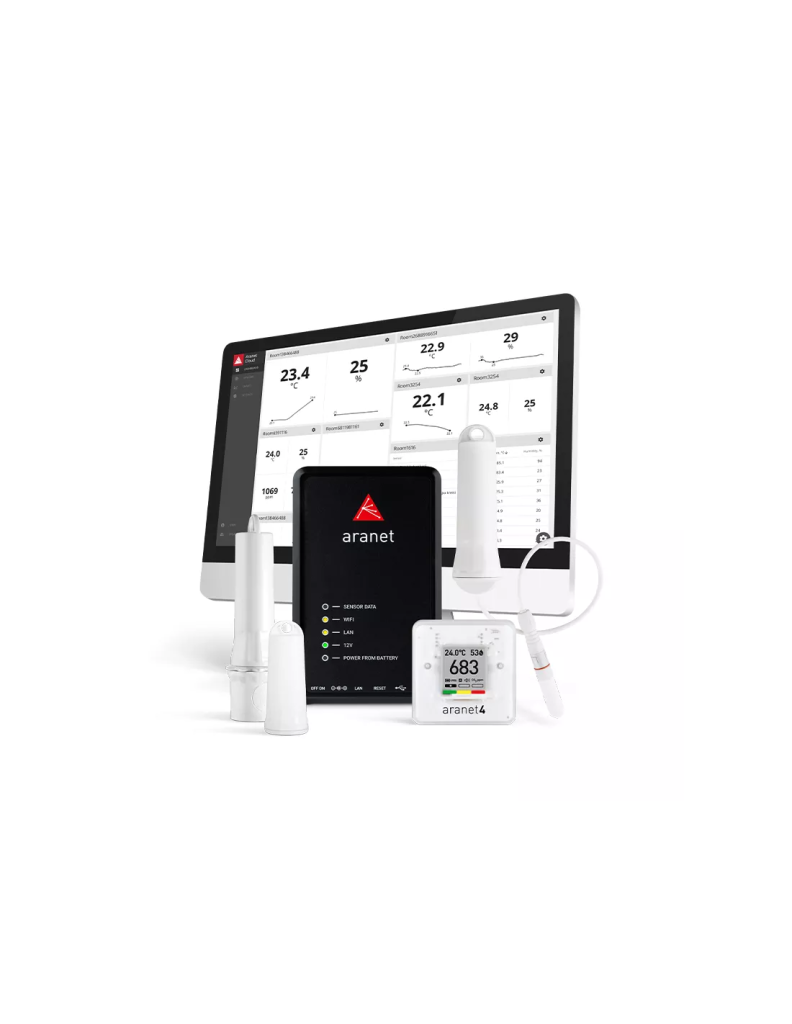
The Question That Is Not Asked Clearly Enough
In high-wire crops, plants do not stay in the same place. Every week, stems are lowered, leaves shift position, and the sensor that was initially aimed at a healthy mature leaf may eventually end up measuring an irrigation pipe or an empty space in the canopy.
A cucumber grower recently asked us about this and it is an excellent question. If leaf temperature data is unreliable, the crop management decisions based on that data will also be unreliable.
Here is what we told him, and what every grower should know before installing an IR sensor.
The Most Common Mistake: Targeting a Specific Leaf
Growers typically direct sensors toward individual healthy, mature, well-exposed leaves — which seems logical at first. But within two weeks, that leaf descends approximately 60 centimeters while the sensor remains stationary. What you thought you were measuring is no longer there.
The right approach is to monitor a consistent crop level rather than an individual leaf. Plant-lowering operations maintain growing head height relatively uniformly — that structural consistency is what should guide sensor placement.
Monitoring a fixed crop level ensures the data series remains consistent and interpretable throughout the entire crop cycle, even as individual leaf positions change week to week.
An Advantage Few Growers Fully Use: The Magnet
The Aranet IR sensor features magnetic mounting. This means:
- No permanent installation required
- Rapid repositioning without tools
- Manual angle adjustment on the fly
The sensor measures 620 mm in length and weighs 600 grams, requiring a clean, rigid, non-flexible support for a stable magnetic connection.
Where to Position the Two Sensors
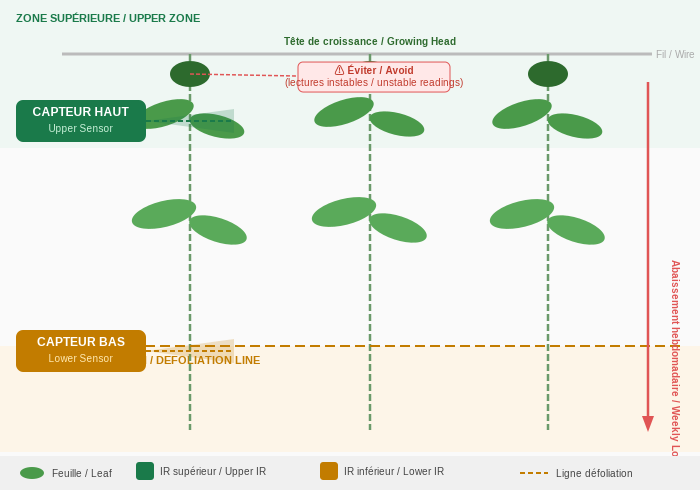
Upper Sensor
Aim it at young, fully developed leaves positioned below the growing head, in a well-exposed section of the canopy. Avoid pointing directly at the growing tip: this ventilated area produces unstable, unrepresentative readings.
Lower Sensor
Position it relative to the current defoliation line, not a fixed absolute height. This sensor requires more frequent monitoring and verification, as the defoliation line continuously changes.
Distance and Angle: Understanding the 5° Field of View
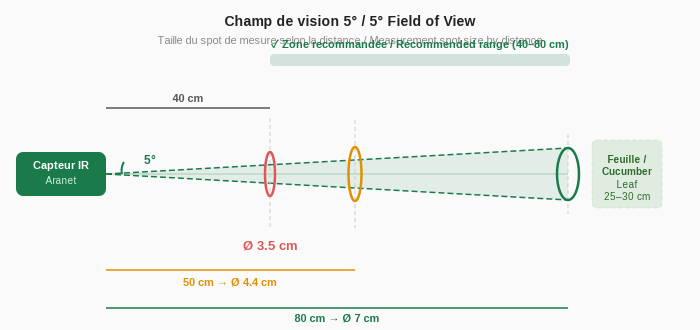
The Aranet IR sensor features a 5-degree field of view, creating measurement spots of approximately:
- 3.5 cm diameter at 40 cm
- 4.4 cm diameter at 50 cm
- 7 cm diameter at 80 cm
Since cucumber leaves measure 25–30 cm across, maintaining a distance of 40–80 cm ensures the measurement spot stays well within the leaf surface with a comfortable safety margin.
The optimal angle is downward-diagonal into the canopy face, not horizontal along the row. Horizontal orientation risks measuring irrigation infrastructure, greenhouse floors, or walls when canopy gaps appear — potentially pushing readings well beyond the stated ±1°C accuracy rating.
The Verification Procedure: The Most Overlooked Step
Initial positioning alone is not enough. The canopy changes continuously, and regular verification is essential after each plant-lowering operation:
- Visually confirm the sensor is targeting leaf tissue
- Manually adjust the angle when necessary
- Reposition the sensor if the crop level has shifted
- Document intervention dates
Recording adjustment dates prevents a sensor-repositioning artifact from being mistaken for an actual physiological change in the crop.
⚠ WARNING SIGNS :
- Leaf temperature closely matches air temperature → the sensor may no longer be aimed at leaf tissue
- Sudden significant temperature drop → the sensor may be measuring a cooler object (floor, irrigation pipe)
Leaf VPD vs. Air VPD: What Is the Difference?
Both measurements are available through Aranet Cloud, but they are calculated differently.
Air VPD
Calculated using temperature and relative humidity from T/RH sensors positioned above the canopy with radiation shields.
Leaf VPD
Combines leaf surface temperatures from IR sensors with temperature and humidity data. It represents the conditions plants actually experience at the stomatal level — particularly valuable for greenhouse climate management decisions.
How Many Sensors Are Needed for One Hectare of High-Wire Cucumbers?
A single central monitoring point cannot accurately represent conditions across an entire hectare. VPD varies significantly between greenhouse centers and perimeters.
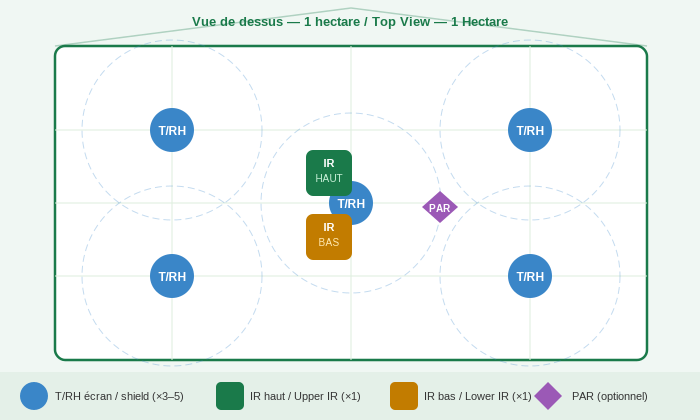
For reliable monitoring across a one-hectare production zone, we recommend the following configuration:
| Sensor | Quantity | Positioning |
|---|---|---|
| T/RH sensor with radiation shield | 3 to 4 | Distributed between the centre and perimeter areas, including one at fruit-cluster level |
| IR leaf temperature sensor | 2 | Upper canopy and defoliation line |
| PAR sensor | 1, optional | Used to interpret temperature peaks during periods of high solar radiation |
A single central monitoring point cannot accurately represent the conditions experienced throughout an entire one-hectare zone.
VPD can vary significantly between the centre of the greenhouse and the perimeter. In this case, sensor redundancy is not wasteful—it provides better spatial representation.
Key Takeaways
Monitor a consistent canopy level, not an individual leaf
Use the magnet to reposition after every lowering operation
Maintain 40–80 cm distance with a downward-diagonal angle
Visually verify after each lowering and document interventions
Watch for leaf temperature approaching air temperature — it is a warning sign
Combine IR + T/RH + radiation shield for a reliable leaf VPD
“The Aranet IR sensor is not difficult to use — but like any precision instrument, it only measures what it is aimed at. Thoughtful positioning and consistent verification prove more valuable than a perfect installation that is never subsequently inspected.”
Suggested category: Greenhouse Technology / Sensors & Data
Tags: Aranet, leaf temperature, VPD, high-wire cucumber, IR sensor, controlled-environment agriculture
Want to develop a customized sensor deployment plan for your specific greenhouse configuration?
→ Contact us
Author: Jordan Goulet