Your Irrigation System Can Look Fine and Still Be Losing Performance
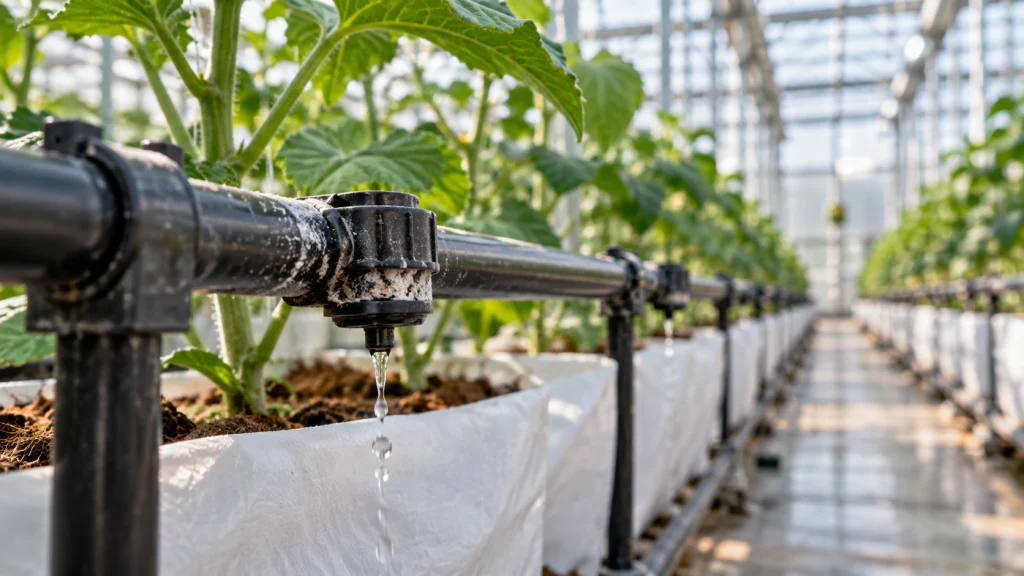
A greenhouse irrigation system rarely fails all at once. More often, small changes develop gradually: an emitter delivers less water than expected, deposits appear inside narrow passages, or distribution becomes less uniform even though the system still seems to operate normally.
That is why preventive irrigation maintenance deserves attention in modern greenhouse production. The objective is to understand the condition of the infrastructure before a minor issue becomes a costly corrective maintenance project.
SafeGrow AG is a stabilized hypochlorous acid (HOCl)-based product positioned for irrigation infrastructure maintenance. Its use should be evaluated according to the manufacturer’s current technical documentation, the characteristics of the irrigation system and the compatibility of the complete fertigation program.
Can irrigation emitters lose performance even when they still work?
Yes. An emitter does not have to stop flowing completely before its discharge changes.
Drip emitters contain narrow internal pathways. Dissolved minerals can pass through filtration and, under certain conditions, precipitate farther downstream. Calcium carbonate and other deposits may contribute to changes in emitter flow and distribution uniformity.
This is an important distinction: flowing does not necessarily mean flowing correctly. When an irrigation system becomes less uniform, the amount of solution delivered at the plant may differ from what the controller was programmed to provide.
Why doesn’t filtration solve every irrigation maintenance problem?
Filtration is essential for capturing suspended particles and debris, but it does not remove every dissolved mineral from irrigation water.
Changes in pH, concentration, temperature and water chemistry can contribute to precipitation inside irrigation infrastructure. A clean filter therefore does not automatically mean that every emitter or irrigation line is free of deposits.
A complete maintenance strategy should consider water quality, filtration, fertigation chemistry, flushing procedures and the actual hydraulic performance of the system.
Why can mineral accumulation become expensive?
Mineral deposits can contribute to restricted flow, uneven distribution and additional maintenance requirements. In a greenhouse, irrigation infrastructure delivers not only water but also carefully managed nutrient solutions.
When distribution becomes less consistent, the precision established upstream may not be reproduced equally at every emitter. Corrective work can also involve labour, flushing, component replacement and downtime.
The economic question is therefore broader than the cost of a maintenance product. It includes the condition of the infrastructure and the cost of keeping the system operating as intended.
What role can preventive maintenance play?
Preventive maintenance aims to identify and address infrastructure issues before they require major corrective work.
SafeGrow AG is positioned by its manufacturer as a product for irrigation infrastructure maintenance. The manufacturer’s information describes its use in programs intended to manage mineral-based accumulation and support the maintenance of irrigation lines.
The extent of these effects depends on the water chemistry, existing deposits, system design and application conditions. Specific improvements in flow, uniformity or deposit accumulation should not be assumed without supporting test data for the intended use.
SafeGrow AG should not be presented as a replacement for appropriate acid cleaning when accumulated mineral scale requires corrective removal.
What exactly is SafeGrow AG?
SafeGrow AG is an irrigation infrastructure maintenance product based on stabilized hypochlorous acid (HOCl). The product information identifies stabilized HOCl as the base of the formulation and indicates a pH range of 5.2–6.2.
The technology is supplied as a manufactured product, allowing growers to evaluate a ready-to-use alternative to on-site HOCl generation. Manufacturer documentation should be consulted for the current product specifications, storage requirements and handling instructions.
SafeGrow AG is not a registered disinfectant and is not intended to be marketed with antimicrobial, pathogen-control or disease-control claims.
Why does stabilization matter?
Stabilization is intended to help maintain the product’s specified characteristics during storage and use. This can be relevant for facilities that need to purchase, store and plan their maintenance supplies.
The manufacturer’s indicated shelf life is 24 months, subject to confirmation in the current technical documentation and applicable batch information. This statement should not be interpreted as an independent contractual guarantee by Hort Americas Canada.
Growers should follow the manufacturer’s storage conditions and verify the applicable expiry or retest information for the product they receive.
Is on-site HOCl generation still an alternative?
Yes. On-site generation may be economically appropriate for some large operations, depending on their volume requirements, equipment costs and technical capabilities.
An on-site system may involve capital equipment, electrode maintenance, calibration, source-water quality and operator attention. A manufactured product offers a different purchasing and logistics model, with the solution supplied by the manufacturer.
Neither approach is automatically the best choice for every greenhouse. The comparison should include the complete cost of ownership, operational requirements and the suitability of the product for the intended maintenance application.
Does SafeGrow AG disinfect irrigation water?
No. SafeGrow AG must not be marketed or used as an irrigation-water disinfectant.
It is positioned as a product for irrigation infrastructure maintenance and does not carry an authorization for disinfection, pathogen control or disease prevention.
If disinfection is the objective, growers must select a product specifically registered for that intended use and follow its approved label. The fact that two products may contain HOCl does not mean they have the same regulatory status, approved applications or permitted claims.
Can SafeGrow AG be used during crop production?
The manufacturer describes SafeGrow AG as intended for irrigation infrastructure maintenance during production. However, any proposed continuous-injection program must be evaluated against the current technical protocol and the specific conditions of the greenhouse.
Before implementation, growers should confirm the recommended application conditions, compatibility with their nutrient program and the suitability of the intended point of injection. A limited-area evaluation is preferable before any facility-wide deployment.
No universal concentration or dosing schedule should be assumed. The appropriate procedure must be established from the manufacturer’s current documentation and the results of the site’s compatibility assessment.
How should compatibility with fertigation be evaluated?
Compatibility is particularly important when a maintenance product is introduced into a fertigation system. HOCl is an oxidizing chemistry and may interact with certain fertilizer components or other materials present in the irrigation solution.
Growers should review potential interactions with chelated micronutrients, including iron chelates such as Fe-EDTA or Fe-DTPA, as well as humic and fulvic substances. The compatibility of the complete nutrient recipe should be confirmed before routine use.
HOCl-based products should not be combined with beneficial microbial inoculants without specific compatibility evidence. Products containing organisms such as Trichoderma, Bacillus or mycorrhizal fungi require particular attention because oxidizing conditions may affect their viability.
Where the manufacturer’s protocol supports injection into a fertigation system, the proposed injection point should be reviewed with the technical team. A downstream injection point after nutrient mixing may be considered, but it must not be treated as a universal recommendation or as proof of compatibility.
Before deployment, validate EC, pH and relevant micronutrient concentrations, and confirm that the nutrient solution remains within the crop’s intended specifications. Changes should be monitored during a controlled trial before expanding the program.
What about residues in irrigation water reaching the crop?
Growers should obtain written manufacturer documentation addressing the intended application, expected residual characteristics and any applicable requirements for irrigation water reaching food crops.
The presence of HOCl in a maintenance product does not, by itself, establish that every residual level or crop-contact condition is appropriate. No general claim of food safety, residue-free application or unrestricted crop contact should be made without supporting documentation.
For food-producing operations, the proposed program should be reviewed in the context of the facility’s food-safety requirements and the manufacturer’s technical guidance before implementation.
Why is calibration more important than simply adding more product?
More chemistry is not automatically better maintenance.
Any dosing program should be based on the manufacturer’s current written protocol and the characteristics of the irrigation system. Water quality, system volume, injection equipment and measurements at relevant points in the network may all influence the evaluation.
Growers should avoid improvising concentrations or increasing doses in an attempt to correct an unidentified problem. A controlled trial, documented measurements and technical review provide a more reliable basis for deciding whether a maintenance program is appropriate.
How can growers measure irrigation performance?
Visual inspection is useful, but it should not be the only method used to assess irrigation performance.
Growers can collect water from representative emitters over a defined period and compare discharge across different zones. Measurements near the beginning and end of irrigation lines can help identify differences, while repeated tests allow changes to be tracked over time.
The same measurement method should be used consistently, with attention to operating pressure, irrigation duration and other relevant conditions. These records provide a baseline for evaluating maintenance needs and the results of any intervention.
When did you last measure emitter discharge rather than simply looking at the system?
Why is preventive maintenance relevant in high-tech greenhouses?
Modern greenhouse production relies on precise irrigation timing, nutrient recipes, EC, pH, substrate moisture and automated control systems. These upstream decisions ultimately depend on the irrigation infrastructure delivering solution as intended.
A preventive maintenance strategy combines regular measurements, water-quality management, appropriate cleaning procedures and documented evaluation of maintenance products.
SafeGrow AG may be considered as one component of that strategy where the manufacturer’s substantiated claims, technical protocol and compatibility information support the intended use. It should not be viewed as a universal solution or a substitute for diagnosing the underlying cause of irrigation problems.
What should growers verify before selecting a maintenance product?
Before introducing a product into an irrigation system, growers should confirm its intended purpose, current technical documentation, compatibility with fertilizer recipes and biological products, application conditions and any relevant crop-contact or residue information.
They should also establish baseline measurements, define the objectives of the trial and determine how results will be evaluated. Where performance claims are being considered, supporting test data should be available before those claims are relied upon.
The goal is to choose a maintenance approach that is technically appropriate, measurable and compatible with the operation.
Better irrigation maintenance starts with better information
A functioning irrigation system is not necessarily operating at its intended performance. Regular measurement and preventive maintenance can help growers understand the condition of their infrastructure and identify issues before they become more disruptive.
SafeGrow AG is a product to evaluate within this broader maintenance strategy, subject to the manufacturer’s documentation and the specific requirements of the greenhouse.
The objective is not to add another chemical to the operation without a clear purpose. It is to maintain irrigation infrastructure through a documented, compatible and measurable process.
Explore SafeGrow AG
Hort Americas Canada distributes SafeGrow AG and can assist professional growers in obtaining current product documentation and reviewing the technical information relevant to their intended irrigation maintenance application.
View SafeGrow AG product information
For technical questions or to request supporting documentation, contact Hort Americas Canada.
Important product and regulatory notice
SafeGrow AG is an irrigation infrastructure maintenance product and is not registered or marketed as a disinfectant. No antimicrobial, pathogen-control, disease-control or crop-performance claims are made in this article.
Hort Americas Canada is a distributor and is not the manufacturer of SafeGrow AG. This content is provided for general informational purposes and does not constitute a universal dosing protocol, a guarantee of performance, or an assurance of compatibility with any particular irrigation system, fertilizer recipe, biological product or crop.
All applications must follow the manufacturer’s current written technical instructions and applicable Canadian requirements. Growers should obtain confirmation of product suitability, fertigation compatibility and relevant crop-contact or residue information before implementation. Where supporting documentation is unavailable, the intended application should not be assumed to be appropriate.