Greenhouse Sanitation Is Evolving: Why Growers Are Looking Beyond the Price per Litre
For many years, strong chemical products were associated with effective sanitation. Today, commercial growers are evaluating sanitation programs more broadly, considering not only the disinfectant itself but also labour, equipment compatibility, documentation and the practical requirements of each application.
Modern horticultural operations contain sophisticated equipment, sensitive materials and production environments where consistency matters. The goal is to maintain appropriate hygiene standards while selecting products and procedures that fit the operation.
Stabilized hypochlorous acid (HOCl) is one technology worth evaluating for registered disinfection applications. However, the suitability of any product depends on its approved label, the intended use and the surfaces or facilities involved.
Why is sanitation more complicated than making surfaces look clean?
Cleaning and disinfection are two different steps. Cleaning removes dirt, organic matter and physical residues, while disinfection is performed using a registered product according to its approved directions.
A professional sanitation program should identify the surfaces being treated, the required preparation, the appropriate product and the applicable contact time. These details help create a procedure that can be repeated and documented consistently.
In greenhouse operations, sanitation may involve areas such as packing facilities, workspaces and other infrastructure. The presence of a greenhouse does not automatically make every disinfection application an approved use. Each intended application must be assessed against the product’s registered settings and label directions.
Why are growers evaluating alternatives to traditional bleach?
Sodium hypochlorite remains an established disinfectant with legitimate applications. However, the purchase price of a chemical is only one part of the cost of a sanitation program.
Growers may also need to consider worker handling, surface compatibility, rinsing requirements, storage, odour, labour, downtime and documentation. A product that is inexpensive per litre may still involve additional operational costs depending on how it must be used.
The objective is not necessarily to replace every traditional disinfectant. It is to select the right chemistry and procedure for each approved application.
What is stabilized hypochlorous acid?
Hypochlorous acid, commonly abbreviated HOCl, is a chlorine-based chemistry. Stabilization allows HOCl to be manufactured and supplied as a ready-to-use product rather than requiring on-site generation immediately before application.
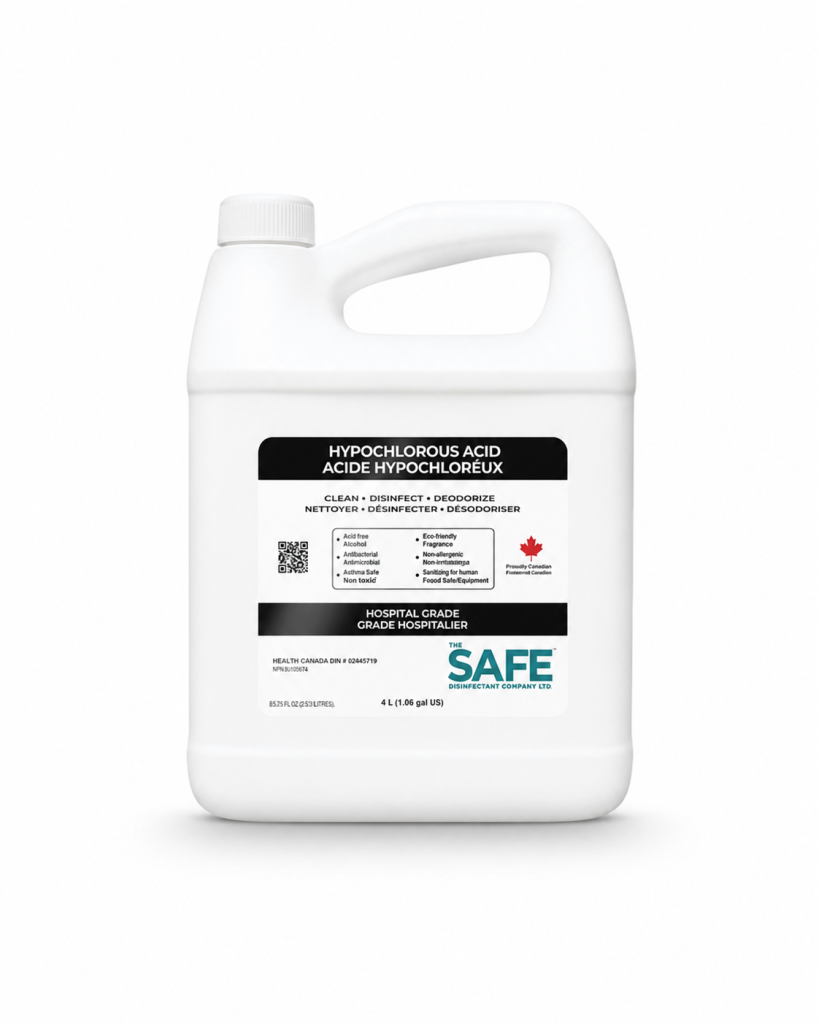
The Safe Disinfectant Company manufactures stabilized HOCl products, including HYCLOSOL. For facilities considering this technology, a manufactured product may offer logistical advantages, such as avoiding the installation and maintenance of an on-site generation system.
That does not mean manufactured HOCl is the most economical choice for every operation. Larger facilities may have different requirements, and the total cost should be evaluated according to the actual sanitation program.
What is the regulatory status of HYCLOSOL in Canada?
Health Canada’s Drug Product Database lists HYCLOSOL, manufactured by The Safe Disinfectant Company Inc., under DIN 02547570. The listing identifies a marketed disinfectant containing 0.046% w/w hypochlorous acid.
The registered settings include hospital and health-care facilities, food premises, barns, and institutional or industrial applications. The DIN should not be interpreted as a blanket approval for all horticultural or greenhouse uses.
For greenhouse businesses, an application must be connected to an approved setting and must comply with the current product label. For example, a proposed use in a food-premises area or an industrial workspace must still be evaluated against the exact label directions, including the surface, application method, concentration and contact time.
Always consult the current Health Canada-approved label before selecting or implementing a disinfection protocol.
Why does regulatory documentation matter in commercial horticulture?
Growers increasingly operate within audited supply chains and food-safety programs. Customers, certification bodies and internal quality systems may require records showing which products were used and how sanitation procedures were performed.
Useful documentation may include the product’s DIN, approved label, batch identification, applicable technical information and records of the procedure used. Where available, manufacturer documentation such as Certificates of Analysis can also support traceability.
The value of a sanitation product is therefore not limited to its purchase price. Its ability to fit into a documented, repeatable process is also important.
What should growers consider when evaluating stabilized HOCl?
A manufactured, stabilized HOCl product may be attractive to operations seeking a simpler supply and handling process. The manufacturer describes its technology as designed to maintain product stability and consistency over its stated shelf life.
Material compatibility is another consideration. According to manufacturer information, the formulation has a low corrosive potential under specified conditions. This should not be interpreted as a guarantee that every metal, plastic, sensor or other component will be unaffected.
Before routine use, growers should review the manufacturer’s compatibility information and perform a test on a representative surface or component where appropriate. Sensitive equipment should be assessed carefully, and all handling requirements must follow the approved label and applicable safety documentation.
Can HYCLOSOL be used on food-contact surfaces?
HYCLOSOL’s registered settings include food premises, but that does not automatically authorize every food-contact application.
Any proposed use on food-contact surfaces must be supported by the current approved label. The applicable concentration, contact time, rinsing requirements and other conditions must be followed exactly.
Growers should not assume that a general description such as “food safe” means a product can be applied at any concentration, directly to produce, or without rinsing. Those uses require specific authorization under the applicable product directions.
Which application methods should be considered?
Application methods must be selected from the current approved label for the specific intended use. The Health Canada Drug Product Database identifies HYCLOSOL in solution and spray dosage forms, but the full label must be consulted to determine the permitted procedures and conditions.
A sanitation plan should not assume that spraying, soaking, immersion or any other method is authorized simply because it is commonly used in horticulture. The intended surface, setting and method must all be supported by the registered directions.
The safest approach is to build the procedure around the approved label rather than adapting a general product description to a new application.
Why is surface compatibility part of the total cost?
Greenhouse infrastructure can include metal structures, plastic components, conveyors, benches, sensors and other costly equipment. Repeated sanitation procedures may affect materials differently depending on the chemistry, concentration, exposure time and surface characteristics.
A product’s compatibility profile should therefore be evaluated alongside its disinfectant registration. Manufacturer data and representative compatibility testing can help determine whether a product is suitable for the intended equipment.
The cheapest litre is not necessarily the least expensive sanitation program if additional labour, rinsing, downtime or equipment maintenance is required.
Is a higher concentration always better?
No. For registered disinfectants, the correct concentration and contact time are determined by the approved label.
Using more product than directed does not automatically improve the procedure. It may increase costs, create unnecessary exposure, affect materials or move the application outside the conditions under which the product was evaluated.
The objective is to use the appropriate product at the required concentration, on the approved surface, for the specified contact time.
Why must cleaning come before disinfection?
A disinfectant should not be expected to replace proper cleaning. Dirt, organic matter and other residues must be removed as required by the sanitation protocol before the disinfection stage.
The process should be understood as two distinct tasks: cleaning prepares the surface, and disinfection treats it according to the approved product directions.
Applying additional disinfectant is not a substitute for following the required preparation and application procedure.
How can a practical sanitation program support consistency?
A sanitation program must be effective on paper and practical enough to implement consistently. Procedures that are clearly documented, manageable for employees and compatible with the operation may be easier to repeat correctly.
This is why growers should evaluate the complete workflow rather than focusing only on chemical cost. Training, preparation, application time, rinsing requirements, recordkeeping and equipment considerations all influence the overall process.
Stabilized HOCl may offer operational advantages in certain registered applications, but those advantages should be evaluated against the facility’s actual needs and the requirements of the approved label.
What should growers ask before choosing a disinfectant?
Before selecting a product, growers should confirm that the intended setting, surface and application method are registered. They should also review the required concentration and contact time, whether rinsing is necessary, compatibility with the equipment, employee handling requirements and the documentation available.
The final consideration is the total process cost, including labour, downtime, consumables and any equipment-related requirements. These questions provide a more complete picture of value than the price per litre alone.
The future of sanitation is about the right chemistry and the right process
Modern horticulture is increasingly focused on precision, efficiency and repeatable operations. Sanitation should follow the same principles.
Stabilized HOCl is worth evaluating where its registered uses and technical characteristics align with the facility’s needs. It is not a universal replacement for other disinfectants, nor does one registration authorize every possible application.
A well-designed sanitation program uses the appropriate product for each task, follows the approved directions and considers the full operational cost.
Effective sanitation is not about using the harshest chemistry. It is about using the right product, in the right way, for the right application.
Explore HYCLOSOL
Hort Americas Canada distributes HYCLOSOL and can assist professional customers in obtaining product information and reviewing the documentation relevant to their intended application.
View HYCLOSOL product information
For technical questions or assistance evaluating a sanitation program, contact Hort Americas Canada.
Important regulatory notice
Hort Americas Canada is a distributor and is not the manufacturer or DIN holder of HYCLOSOL. This article is provided for general informational purposes only and does not constitute an approved product label, an authorization for a particular use, or a guarantee of product performance or material compatibility.
All disinfection applications must comply with the current Health Canada-approved label, including the registered setting, intended surface, application method, concentration, contact time and any applicable rinsing or safety requirements. In the event of any discrepancy, the approved label takes precedence. Customers should consult the manufacturer or DIN holder for clarification before implementing an application that is not clearly supported by the label.